


At the beginning of October 2025, the West Nile virus (WNV) was detected for the first time in Belgium in samples collected from wild birds in August 2025. The virus was identified by real-time PCR. in samples from three wild birds — two jackdaws and one crow,collected in Mechelen, Hombeek, and Meise — during August 2025. The analyses were carried out by the Exotic and Vector-borne Diseases unit of Sciensano.
These samples were collected as part of the One Health for Surveillance (OH4S) project, a collaborative initiative between Sciensano, the University of Liège, and the three Belgian regions: Flanders (Agency for Nature and Forests, ANB), Wallonia (Service Public de Wallonie, SPW), and Brussels (Brussels Environment). The project is co-funded by the European Union (Grant Agreement No. 101132473).
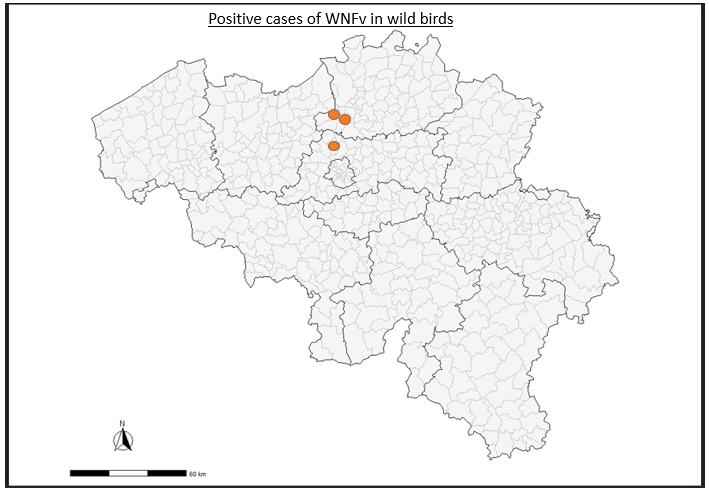 Fig 1. Localisation of WNF-positive cases in wild birds (orange dots) in Belgium (October 16, 2025).
This is the first time that WNV has been detected in Belgium. In other European countries, such as France, the Netherlands, and Germany, in the virus has already been found in horses, birds and humans. Therefore, the Belgian finding fits within the European spread of the virus and is not unexpected.
The current risk of infection with the virus is considered low (link to RAG assessment) as the activity season of vector mosquitoes is coming to an end.
Nevertheless, vigilance remains important, especially at the beginning of the new vector season, when mosquitoes will be active again.